
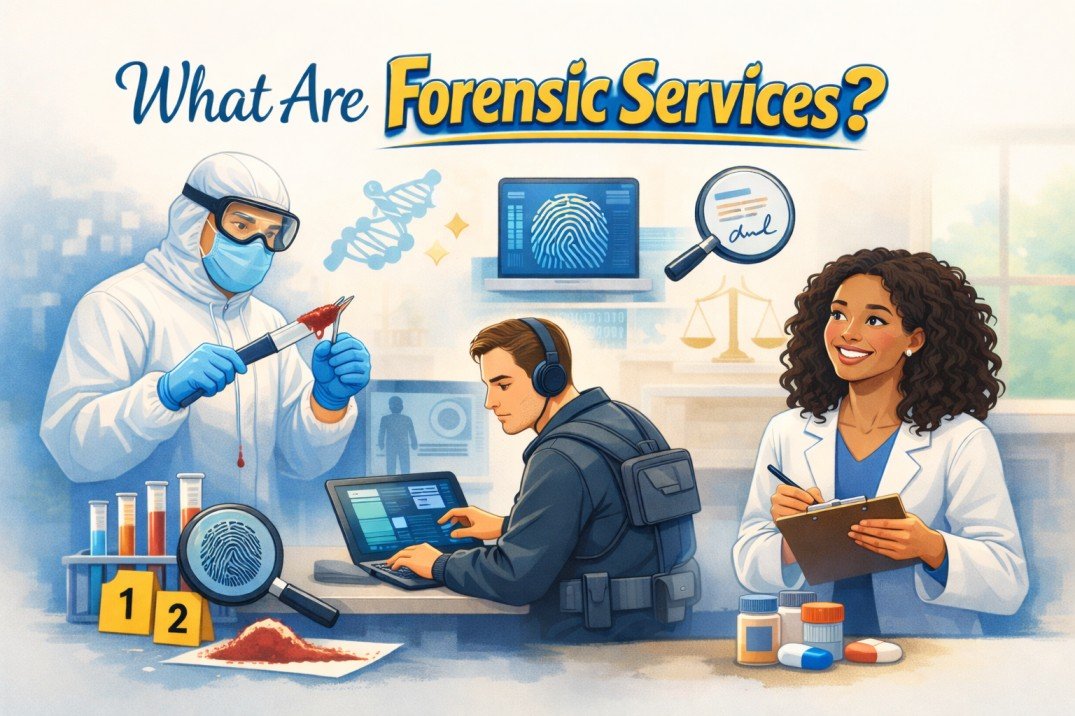
You encounter forensic services whenever a case requires proof based on measurable facts rather than opinion. Law enforcement uses forensic analysis to identify suspects and reconstruct crimes. Attorneys rely on forensic findings to support or challenge claims. Businesses use forensic specialists to investigate fraud, data breaches, and internal misconduct. Medical systems depend on forensic expertise to determine cause and manner of death.
Forensic services support:
- Criminal investigations such as homicide, assault, theft, sexual violence, arson, and cybercrime.
- Civil matters encompass personal injury, malpractice, and disputed contracts.
- Corporate and financial investigations encompass activities such as embezzlement, asset concealment, and accounting irregularities.
- Identification of unknown individuals and disaster victims.
The process also involves the authentication of documents and digital records.
Main Types of Forensic Services
Forensic Biology and DNA Analysis
DNA testing examines genetic material from blood, saliva, skin cells, hair roots, or bone. Laboratories compare specific genetic markers to known samples or databases. DNA analysis can identify suspects, confirm victims, and establish biological relationships.
Fingerprint and Impression Analysis
Fingerprint examiners compare ridge patterns found on surfaces with known prints. Impression evidence also includes footwear and tire tracks. These patterns can associate a person or vehicle with a specific location.
Digital and Multimedia Forensics
Digital forensic specialists extract and analyze data from computers, mobile phones, storage devices, and cloud accounts. They recover emails, messages, images, browsing history, and deleted files. This field plays a central role in cybercrime, fraud, and harassment cases.
Forensic Toxicology
Toxicologists test blood, urine, and tissue for drugs, alcohol, and poisons. Their findings help determine overdose, impairment, or poisoning and often explain unexplained deaths.
Forensic Pathology and Anthropology
Forensic pathologists perform autopsies to determine the cause and manner of death. Forensic anthropologists analyze skeletal remains to estimate age, sex, stature, and trauma.
Forensic Psychology and Psychiatry
These specialists evaluate mental health in legal contexts. They assess competency to stand trial, criminal responsibility, risk of future violence, and psychological harm.
Document Examination
Document examiners analyze handwriting, signatures, ink, paper, and printing methods. They determine whether documents are genuine, altered, or forged.
Forensic Engineering
Forensic engineers investigate structural collapses, vehicle defects, product failures, and industrial accidents to determine why they occurred.
Forensic Accounting
Forensic accountants analyze financial records to uncover fraud, embezzlement, hidden assets, and financial manipulation.
How Forensic Services Work
Forensic professionals follow a structured process grounded in the scientific method.
They first secure and document the scene or source of evidence. They then collect items using procedures that prevent contamination. Each item is labeled and tracked through a documented chain of custody. Specialists analyze the evidence in controlled laboratory settings using validated techniques. Results are interpreted and reported in clear, technical language. When required, experts explain their findings in court.
Every step focuses on accuracy, transparency, and repeatability.
Why Forensic Services Matter in the Justice System
Courts require reliable evidence. Forensic science provides objective findings that do not depend on memory, emotion, or personal interpretation. Scientific testing can confirm or contradict witness statements. It can link a person to a crime or exclude them entirely.
Forensic services have helped solve cold cases, expose wrongful convictions, and uncover complex fraud schemes. Their value lies in turning physical and digital traces into factual conclusions.
What Counts as Forensic Evidence?
Forensic evidence includes any material that can be scientifically examined.
- Biological material such as blood, saliva, semen, and tissue.
- Physical objects such as weapons, tools, glass, and fibers.
- Digital data such as files, messages, and logs.
- Trace materials such as gunshot residue, paint, and soil.
- Documents such as contracts, checks, and handwritten notes.
Evidence must be properly collected and preserved to remain reliable.
Who Provides Forensic Services?
- Public crime laboratories operated by local, state, or federal agencies.
- Private forensic laboratories.
- The offices of medical examiners and coroners are also included.
- Hospitals and universities.
- Independent forensic consultants.
The provider depends on the type of case and jurisdiction.
Careers in Forensic Services
Common roles include forensic scientist, crime scene investigator, digital forensic examiner, forensic pathologist, forensic psychologist, forensic accountant, document examiner, and forensic engineer. Most positions require specialized education and ongoing training.
Frequently Asked Questions
Are forensic reports admissible in court?
Yes. Courts accept forensic reports when methods meet scientific and legal standards and proper chain of custody exists.
Do forensic professionals testify in court?
Yes. They explain how tests were performed and what the results mean.
Can forensic services prove innocence?
Yes. Scientific testing can exclude individuals from involvement.
Final Thoughts
Forensic services transform physical and digital traces into reliable evidence. They provide the scientific foundation that allows the legal system to determine what happened, who was involved, and why, a standard reflected in the forensic and psychological evaluation work performed by Psychological Associates of Melbourne. When accuracy matters, forensic services deliver answers grounded in science rather than speculation.