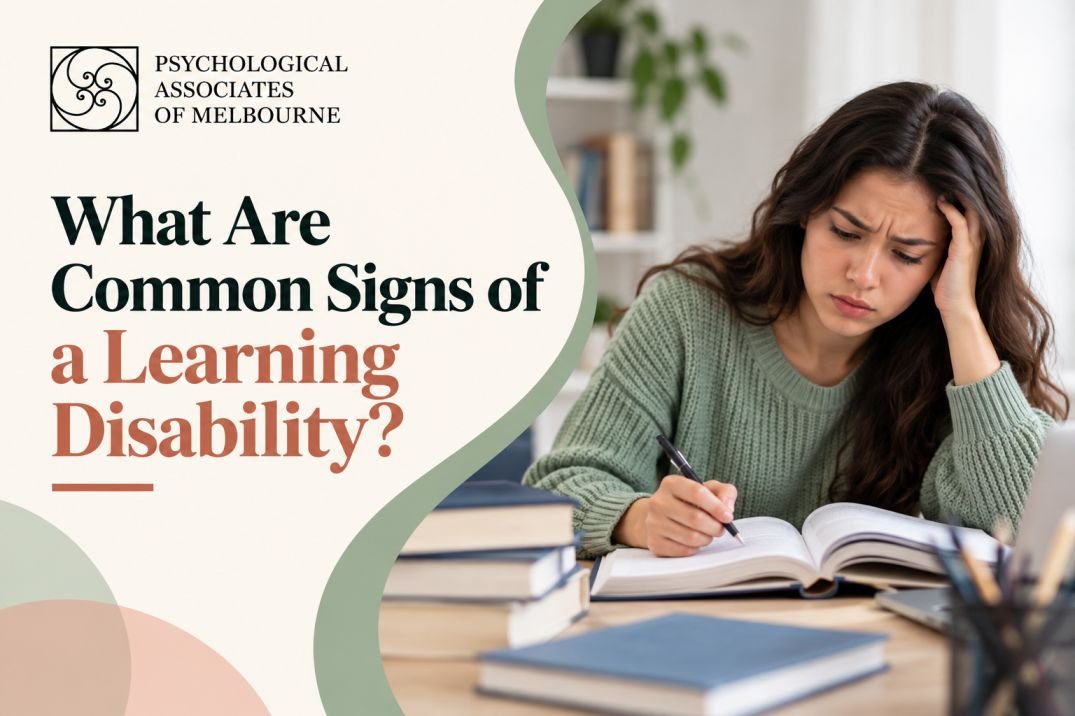
Common signs of a learning disability include persistent difficulty with reading, spelling, written expression, mathematics, or applying specific academic skills. You may notice slow or effortful reading, frequent spelling errors, difficulty organizing written work, trouble understanding number concepts, or problems solving math problems. A single difficulty does not establish a learning disability. A professional evaluation looks at the pattern, persistence, severity, and impact of the difficulties.
What Are the Most Common Signs of a Learning Disability?
Learning disabilities can affect different academic skills, and the signs can look different from person to person. The most important signs usually involve persistent difficulty in one or more specific areas.
Difficulty With Reading
Reading difficulties may involve more than simply disliking books or reading slowly.
Common signs include:
- Reading words inaccurately or very slowly
- Difficulty sounding out unfamiliar words
- Frequently misreading words
- Difficulty reading smoothly or fluently
- Trouble understanding the meaning of written material
- Spelling words incorrectly even after repeated practice
Someone may understand information well when it is explained verbally but struggle when the same information is presented in writing.
Reading impairment is one of the main areas considered when assessing Specific Learning Disorder. Dyslexia is commonly used to describe significant difficulties involving word reading accuracy, reading fluency, decoding, and spelling.
Difficulty With Writing and Spelling
Writing difficulties can affect both the mechanics of writing and the ability to communicate ideas clearly.
You may notice:
- Frequent spelling mistakes
- Difficulty organizing written thoughts
- Problems with grammar or punctuation
- Written work that takes much longer than expected
- Difficulty producing clear, structured written responses
- A noticeable difference between verbal communication and written expression
These difficulties can become particularly noticeable when school, college, or workplace tasks require substantial written communication.
Difficulty With Mathematics
A learning disability involving mathematics can affect much more than advanced calculations.
Common signs include:
- Difficulty understanding number concepts
- Trouble remembering basic math facts
- Persistent calculation errors
- Difficulty understanding mathematical symbols
- Problems applying mathematical concepts
- Difficulty solving mathematical reasoning or word problems
Dyscalculia is commonly used to describe significant difficulties involving number-related concepts, arithmetic facts, calculations, and mathematical reasoning.
What Does a Learning Disability Look Like in Everyday Life?
The signs can become easier to recognize when you look at how a person performs specific tasks rather than focusing on a single symptom.
At school or during training, you may notice that a person needs considerably more time for reading, writing, or math tasks, repeatedly struggles with the same skill, or understands material better when it is explained verbally.
At work, the difficulty may appear when reading detailed instructions, completing written documentation, working with numbers, or learning procedures that depend heavily on a particular academic skill.
Adults may also develop ways of working around their difficulties. For example, someone may rely heavily on spell-checking, avoid tasks involving extensive reading, use a calculator for simple calculations, or ask others to review written work.
These strategies can make a longstanding learning difficulty less obvious. The Australian Psychological Society notes that adults may develop strategies that help them manage or conceal learning difficulties, which can make identification more difficult.
Does Having These Signs Mean You Have a Learning Disability?
No. Having one or several of these difficulties does not automatically mean you have a learning disability.
A professional evaluation considers whether the difficulty is persistent, specific, significant, and interfering with academic, occupational, or everyday functioning. It also considers whether another factor could better explain the difficulty.
For example, difficulties with learning can also be influenced by hearing or vision problems, inadequate educational opportunities, language factors, intellectual disability, neurological conditions, or emotional difficulties. These possibilities need to be considered during an appropriate assessment.
When Are Learning Difficulties More Concerning?
A learning difficulty deserves closer attention when it:
- Has continued over a long period
- Remains difficult despite appropriate instruction or support
- Affects a specific academic skill substantially
- Interferes with school, work, or daily activities
- Has been present since the school years, even if it was not formally identified at the time
Under current diagnostic criteria, difficulties associated with Specific Learning Disorder persist for at least six months despite targeted help and are substantially below what would be expected for the person’s age or developmental level.
What Are the Main Types of Learning Disabilities?
The clinical diagnosis is called Specific Learning Disorder. It can be specified according to the area affected: reading, written expression, or mathematics. Terms such as dyslexia, dysgraphia, and dyscalculia are commonly used to describe these areas of difficulty.
Specific Learning Disorder With Impairment in Reading
This involves significant difficulty with skills such as word reading accuracy, reading speed or fluency, decoding, reading comprehension, or spelling.
Specific Learning Disorder With Impairment in Written Expression
This involves difficulties with spelling, grammar, punctuation, organization, or producing written expression effectively.
Specific Learning Disorder With Impairment in Mathematics
This involves difficulties with number concepts, arithmetic facts, calculations, or mathematical reasoning.
A person can have difficulties in one area or in more than one area. The assessment identifies the specific pattern rather than assuming that every learning difficulty has the same cause.
What Are the Signs of a Learning Disability in Adults?
Learning disabilities can continue into adulthood and may not be formally recognized until later. Increased demands at work, college, or other settings can make longstanding difficulties more noticeable.
Common signs in adults can include:
- Persistent difficulty reading or spelling
- Difficulty producing written work efficiently
- Trouble understanding written instructions
- Difficulty working with numbers or calculations
- Taking unusually long to complete certain reading or writing tasks
- Difficulty learning specific procedures
- Avoiding tasks that involve a longstanding area of difficulty
- A history of similar problems during school
- Relying heavily on compensatory strategies
An adult who has always found reading, spelling, writing, or mathematics unusually difficult may wonder whether a learning disabilities adults test could provide some answers. A formal assessment can examine the specific skills involved and determine whether the pattern is consistent with a learning disorder.
Why Can a Learning Disability Go Unrecognized in Adults?
Some adults become very effective at compensating for their difficulties.
You may have developed strategies such as:
- Spending extra time on written tasks
- Using technology to assist with spelling
- Avoiding jobs that require extensive reading or calculations
- Asking someone else to check written work
- Memorizing information rather than reading it
- Using calculators or other tools for numerical tasks
These strategies can help you function successfully without necessarily explaining why certain tasks have always required more effort.
The Australian Psychological Society notes that adults with specific learning disorders may develop strategies that cover their difficulties, and concerns may only become apparent through vocational or language-based assessment.
How Do You Know If You Should Consider a Learning Disability Evaluation?
Consider a professional evaluation when learning difficulties are persistent and interfere with your education, work, or everyday responsibilities.
Learning disabilities evaluations generally look beyond a symptom checklist. A psychologist may consider your developmental and educational history, current concerns, previous performance, and standardized assessment results.
An evaluation can be particularly useful when you have experienced the same difficulty for years but have never understood why certain tasks require significantly more effort than they seem to require for other people.
The purpose is not simply to give you a label. A comprehensive evaluation can clarify the pattern of strengths and difficulties and help determine whether the difficulties are consistent with a specific learning disorder.
What Tests Are Used for Learning Disabilities?
There is not one single test that can identify every learning disability.
Tests for learning disabilities may examine the academic skills relevant to the person’s concerns, including:
- Reading
- Reading comprehension
- Spelling
- Written expression
- Mathematics
- Number skills
- Mathematical reasoning
A professional may also gather information about developmental, educational, and family history. Standardized psychological and achievement tests can help compare performance with appropriate age-based expectations.
The results should be interpreted together with the person’s history and functional difficulties. Testing scores alone do not provide the complete picture.
What Happens During a Learning Disability Evaluation?
A comprehensive evaluation generally involves more than completing a short questionnaire.
Reviewing Your History
The psychologist may ask about your educational experiences, developmental history, previous academic difficulties, current concerns, and how those difficulties affect your work or everyday life.
Previous school records, reports, or examples of academic performance can sometimes provide useful information, particularly when evaluating longstanding difficulties.
Completing Standardized Assessments
The specific tests depend on the questions being investigated. Assessment may focus on reading, spelling, written expression, mathematics, or related abilities.
The goal is to identify a clear pattern rather than simply determine whether you answered a certain number of questions incorrectly.
Interpreting Strengths and Difficulties
The final interpretation considers the relationship between your test results, history, and current functioning.
Professional assessment also considers whether another explanation better accounts for the learning difficulties. The Australian Psychological Society recommends considering factors such as sensory problems, emotional difficulties, educational factors, language issues, and intellectual disability during assessment.
Can You Take a Learning Disability Test Online as an Adult?
An online questionnaire may help you recognize that you have concerns worth discussing with a professional, but it should not be treated as a substitute for a comprehensive learning disability evaluation.
A test for learning disabilities in adults online may provide general screening information, depending on the tool. It cannot, by itself, establish a clinical diagnosis.
Professional assessment can incorporate standardized testing, interviews, developmental and educational history, and consideration of other possible explanations. The American Psychiatric Association also states that assessment measures are intended to support clinical decision-making rather than serve as the sole basis for diagnosis.
If an online screening result raises concerns, the useful next step is to discuss those concerns with a qualified professional rather than assuming the result confirms a diagnosis.
Learning Disabilities Testing Near Me: What Should You Look For?
If you are searching for learning disabilities testing near me, look for a provider with appropriate training and experience in psychological or learning assessments.
Useful questions to ask include:
- Does the provider evaluate adults as well as younger clients?
- What academic skills are assessed?
- Are standardized tests used?
- Does the evaluation include a review of developmental and educational history?
- How are results explained?
- Will the evaluation consider other possible reasons for the learning difficulties?
- What information should you bring to the appointment?
A comprehensive assessment should give you more useful information than a simple symptom checklist because it examines the pattern and context of your difficulties.
Learning Disabilities Evaluations in Melbourne
For people seeking learning disabilities evaluations in Melbourne, Florida, Psychological Associates of Melbourne provides psychological and neuropsychological evaluation services.
The practice was founded by Dr. Wende J. Anderson, Psy.D., ABPP, who is board certified by the American Board of Professional Psychology. The practice reports more than 20 years of clinical experience and more than 9,500 total evaluations as of July 2026.
A learning evaluation can help clarify whether persistent difficulties with reading, writing, spelling, mathematics, or related academic skills warrant further assessment and what those difficulties mean in the context of your overall functioning.
Common Misconceptions About Learning Disabilities
A Learning Disability Does Not Mean Low Intelligence
A learning disability is not simply a measure of intelligence. Specific learning disorder involves significant difficulty with particular academic skills, such as reading, written expression, or mathematics.
A person can have strong abilities in many areas while experiencing substantial difficulty in one specific academic domain.
Struggling With One Subject Does Not Automatically Mean You Have a Learning Disability
Everyone can struggle with a particular subject or skill at some point.
The important question is whether the difficulty is persistent, significant, and consistent with a broader pattern that cannot be better explained by another factor.
Adults Can Have Learning Disabilities
Learning disabilities generally begin during the school years, but they may not be recognized until adulthood. Higher demands at work or in education can reveal difficulties that were previously managed through support or compensation.
An Online Quiz Is Not the Same as a Professional Evaluation
A screening questionnaire can raise a useful question, but it does not provide the same information as a comprehensive assessment using standardized measures and professional interpretation.
Frequently Asked Questions
What are the first signs of a learning disability?
Early signs can include persistent difficulty developing reading, spelling, writing, or mathematics skills. Difficulties with language, following directions, or learning certain sequences may also raise concerns, depending on the person’s developmental stage.
What are the most common signs of a learning disability?
The most common signs involve persistent difficulties with reading, written expression, spelling, mathematics, or mathematical reasoning. The specific pattern varies from person to person.
Can adults have a learning disability?
Yes. Learning disabilities can continue into adulthood and may remain unrecognized until work, college, or other demands make the difficulties more noticeable.
What tests are used for learning disabilities?
Assessment can include standardized measures of academic skills such as reading, spelling, writing, mathematics, and mathematical reasoning. A psychologist also considers history and other relevant information when interpreting the results.
Does a learning disability affect intelligence?
A learning disability is not the same as low intelligence. Specific learning disorder describes persistent difficulty with particular academic skills rather than a general measure of intellectual ability.
Can adults take a learning disability test online?
Online screening tools may help identify concerns, but they should not be treated as a replacement for a comprehensive professional evaluation. A diagnosis requires appropriate clinical assessment and interpretation.
When should I consider a learning disability evaluation?
Consider an evaluation when a specific learning difficulty has persisted over time, continues despite appropriate support, and interferes with education, work, or everyday activities.
Where can I get learning disabilities testing near me?
Look for a qualified psychologist or assessment provider with experience evaluating learning difficulties. If you are in the Melbourne, Florida area, Psychological Associates of Melbourne provides psychological and neuropsychological evaluation services.
Conclusion
The common signs of a learning disability usually involve a persistent pattern of difficulty with reading, written expression, spelling, mathematics, or mathematical reasoning. The presence of one symptom does not establish a learning disability. What matters is the pattern, persistence, severity, and effect on everyday functioning.
Adults can also have learning disabilities, even when they have spent years developing strategies to compensate for them. If longstanding learning difficulties continue to interfere with work, education, or daily responsibilities, a professional evaluation can provide a clearer understanding of the underlying pattern.
For those looking for learning disabilities evaluations in Melbourne, Psychological Associates of Melbourne provides psychological and neuropsychological evaluation services to help identify areas of difficulty and strength and determine whether further professional support is appropriate.
Also Read:
What Are the 7 Main Types of Learning Disabilities?