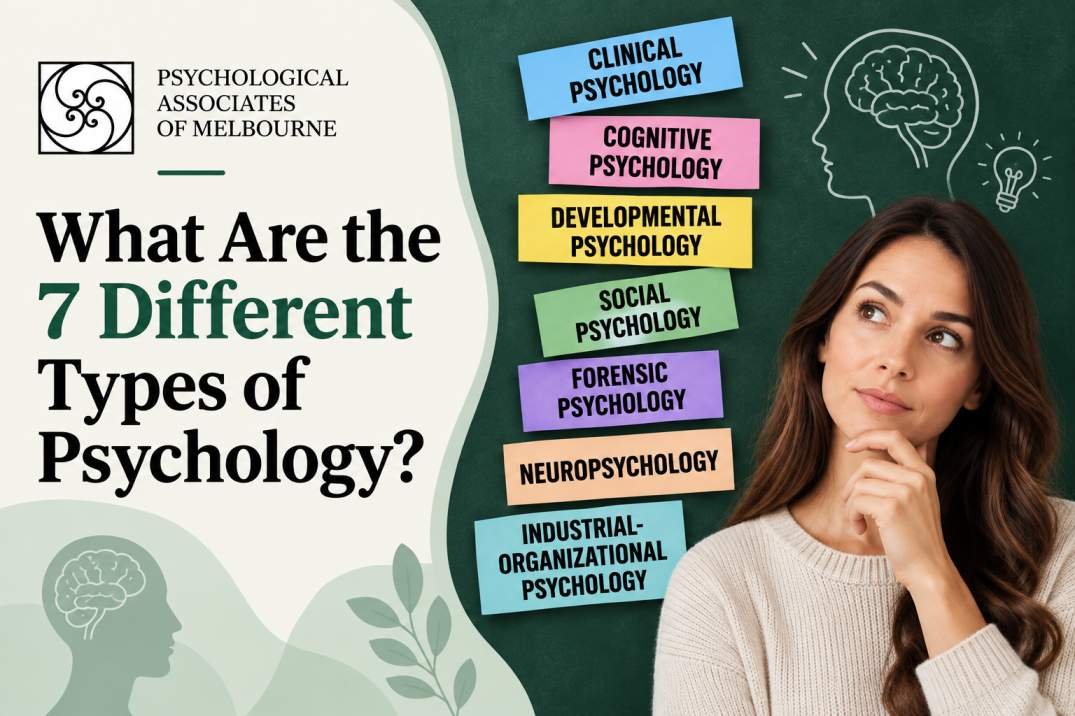
The seven commonly discussed types of psychology are clinical psychology, cognitive psychology, developmental psychology, social psychology, forensic psychology, neuropsychology, and industrial-organizational psychology. Each focuses on a different aspect of human behavior, mental processes, development, brain functioning, social interaction, or work environments.
There is no universal rule that psychology has exactly seven branches. Psychology is a broad field with many subfields and professional specialties. The American Psychological Association, for example, recognizes a range of specialties, including clinical psychology, clinical neuropsychology, counseling psychology, forensic psychology, industrial-organizational psychology, and school psychology.
So when you see a list of the “7 different types of psychology,” the specific seven can vary by source. The seven below provide a useful way to understand several major areas of the field.
Are There Really Only 7 Types of Psychology?
No. Psychology has many branches, specialties, and areas of research, so there is no single official list containing exactly seven types.
Different sources organize psychology in different ways. Some lists include counseling psychology, school psychology, health psychology, personality psychology, or behavioral psychology. Others emphasize clinical, cognitive, developmental, social, forensic, neuropsychology, and industrial-organizational psychology.
The difference usually comes from how a source defines a “type.” It may be referring to a broad academic subfield, a professional specialty, an applied area, or a theoretical perspective.
The APA’s current materials show this breadth. Its psychology resources include categories such as clinical, cognitive, developmental, forensic, industrial-organizational, neuropsychology, social, educational, and school psychology.
That is why it is more accurate to describe the following as seven commonly discussed areas of psychology rather than claim that they are the only seven.
What Are the 7 Main Types of Psychology?
1. Clinical Psychology
Clinical psychology focuses on psychological disorders, emotional difficulties, behavior, and psychological functioning. Clinical psychologists apply psychological science to the assessment and treatment of complex human problems.
Clinical psychology can involve psychological assessment, diagnosis, psychotherapy, and other evidence-based interventions, depending on the psychologist’s training, setting, and scope of practice.
A clinical psychologist may work with concerns such as anxiety, depression, trauma, behavioral difficulties, or other mental health conditions.
Clinical psychology is also closely connected to psychological evaluation. When an assessment is needed to answer a specific diagnostic or clinical question, a psychologist may use interviews, standardized tests, records, observations, and other relevant information.
2. Cognitive Psychology
Cognitive psychology studies how people process information. It focuses on mental processes such as:
- Attention
- Memory
- Learning
- Perception
- Reasoning
- Decision-making
- Problem-solving
For example, a cognitive psychologist may study how people remember information, why attention becomes divided, or how people make decisions under different conditions.
Cognitive psychology is particularly useful for understanding the relationship between mental processes and behavior. It also overlaps with neuroscience and neuropsychology, although those fields ask different types of questions.
3. Developmental Psychology
Developmental psychology examines how people grow, change, and adapt across the lifespan.
It can involve changes in:
- Thinking and learning
- Emotional functioning
- Social relationships
- Behavior
- Identity
- Communication
Developmental psychology is not limited to childhood. Developmental psychologists may study changes during adolescence, adulthood, and later life as well.
The focus is on understanding how psychological functioning changes over time and what factors contribute to those changes. The APA describes developmental psychology as the study of how people grow and adapt over the course of their lives.
4. Social Psychology
Social psychology examines how other people and social environments influence thoughts, feelings, and behavior.
It can involve topics such as social influence, attitudes, interpersonal relationships, group behavior, prejudice, and social perception.
For example, social psychologists may study why people behave differently in groups, how social expectations influence decisions, or how relationships affect behavior.
Social psychology is different from clinical psychology because its central focus is the interaction between people and their social environments rather than primarily the assessment and treatment of psychological disorders.
5. Forensic Psychology
Forensic psychology applies psychological knowledge to legal, judicial, and administrative questions.
Forensic psychology can involve psychological expertise in areas such as legal proceedings, assessment, expert testimony, correctional settings, and other matters involving the legal system.
It is broader than simply studying criminal behavior. The APA describes forensic psychology as the application of psychological knowledge to law and legal, contractual, and administrative matters.
A forensic psychologist may therefore use psychological knowledge to address a specific legal question rather than provide ordinary mental health treatment.
6. Neuropsychology
Neuropsychology examines the relationship between brain functioning and behavior.
It is particularly concerned with cognitive and behavioral changes associated with neurological conditions, brain injuries, and other changes affecting the nervous system.
A neuropsychologist may assess areas such as:
- Memory
- Attention
- Processing speed
- Language
- Executive functioning
- Problem-solving
- Emotional and behavioral functioning
Neuropsychology has a strong connection to psychological assessment because specialized testing can help evaluate cognitive and behavioral functioning.
The APA identifies neuropsychology as a distinct area and describes neuropsychologists as professionals who explore relationships between brain systems and behavior.
7. Industrial-Organizational Psychology
Industrial-organizational psychology, often called I-O psychology, focuses on human behavior in workplaces and organizations.
It can address:
- Employee selection
- Training
- Motivation
- Leadership
- Job performance
- Team functioning
- Organizational change
- Workplace well-being
I-O psychologists apply psychological research and principles to workplace issues. The APA notes that professionals in this area may work in staffing, training, employee development, testing, management consulting, and organizational change.
This branch shows why psychology extends beyond clinical treatment. Psychological research can also be applied to how people work, learn, communicate, and perform within organizations.
How Are the 7 Types of Psychology Different?
The main difference is the question each area is designed to answer.
| Type of Psychology | Main Focus | Example Area |
| Clinical Psychology | Mental health and psychological functioning | Assessment and treatment |
| Cognitive Psychology | Thinking and information processing | Memory and attention |
| Developmental Psychology | Psychological change across life | Development and adaptation |
| Social Psychology | Social influence and interaction | Groups and relationships |
| Forensic Psychology | Psychology and legal systems | Legal assessment and expertise |
| Neuropsychology | Brain and behavior | Cognitive functioning |
| Industrial-Organizational Psychology | Workplace behavior | Hiring, training, and performance |
These areas can overlap. For example, a clinical neuropsychologist may work with both clinical and neuropsychological questions, while forensic work can draw on clinical, cognitive, developmental, or social psychology depending on the legal issue being addressed. The APA’s own materials recognize substantial overlap among psychology subdisciplines and specialties.
What Is the Difference Between Psychology Branches, Specialties, and Perspectives?
These terms are related but do not mean exactly the same thing.
A psychology branch or subfield generally describes an area of study, such as cognitive or developmental psychology.
A professional specialty describes a recognized area of professional practice. The APA, for example, recognizes specialties including clinical psychology, counseling psychology, clinical neuropsychology, forensic psychology, school psychology, and industrial-organizational psychology.
A psychological perspective is a way of explaining behavior or mental processes. Examples include biological, behavioral, cognitive, psychodynamic, humanistic, and sociocultural perspectives.
This distinction matters because a list of seven branches is not necessarily the same thing as a list of seven psychological perspectives.
How Does Psychological Assessment Fit Into Psychology?
Psychological assessment is a process used to gather and interpret information about psychological functioning. It is not a separate eighth type of psychology.
Depending on the purpose, a psychological assessment may examine areas such as cognitive functioning, attention, learning, emotional functioning, behavior, personality, or other psychological concerns.
A thorough assessment does not necessarily depend on one test. The APA’s guidelines state that psychologists conducting testing, assessment, and evaluation should use multiple relevant and reliable sources of clinical information. These can include interviews, observations, records, self-report measures, third-party reports, and psychological tests.
The reason for the assessment determines what information and testing methods are appropriate.
What Is the Difference Between Psychological Testing and Psychological Evaluation?
Psychological testing refers to the use of standardized measures to assess specific areas, while a psychological evaluation is a broader process that can combine testing with interviews, history, records, observations, and professional interpretation.
Psychological testing may measure specific abilities, characteristics, symptoms, or areas of functioning.
A psychological evaluation considers test results in context. The psychologist may also review relevant history, discuss current concerns, examine records, and integrate information from several sources.
This distinction is important because a test score by itself does not necessarily explain why a person is experiencing a particular difficulty.
The APA’s assessment guidelines emphasize that individual test performance is only one part of the assessment process and should be interpreted in the context of the presenting concern, reason for referral, background, and other relevant information.
What Happens During a Psychological Evaluation?
A psychological evaluation varies according to its purpose, but the process commonly involves several stages.
Identifying the Reason for the Evaluation
The first step is understanding what question the evaluation needs to answer.
For example, the purpose may involve a diagnostic question, cognitive concerns, attention difficulties, learning concerns, emotional symptoms, or another clearly defined issue.
Gathering Background Information
The psychologist may ask about relevant personal, medical, educational, developmental, or psychological history.
Previous evaluations and other records may also provide useful information when they are relevant to the assessment.
Completing Psychological Testing
The psychologist selects testing methods based on the purpose of the evaluation.
Testing may examine areas such as cognitive abilities, attention, memory, learning, personality, emotional functioning, or other relevant areas.
Not every evaluation requires the same tests.
Interpreting the Information
The psychologist considers the results together with the interview, history, records, observations, and other relevant information.
This broader interpretation helps place test results in context. The APA specifically recommends using multiple sources of relevant and reliable information during psychological testing, assessment, and evaluation.
Reviewing Findings
The final findings depend on the type and purpose of the evaluation.
Written documentation may explain the assessment findings and, when appropriate, provide recommendations related to the question that prompted the evaluation.
When Might Someone Need Psychological Assessment Services?
People may seek psychological assessment services for different reasons. The appropriate type of assessment depends on the question that needs to be answered.
Examples can include:
- Clarifying a diagnostic concern
- Understanding attention or cognitive functioning
- Evaluating learning difficulties
- Assessing emotional or behavioral concerns
- Understanding psychological symptoms
- Evaluating functioning related to a specific professional or disability-related question
A psychological assessment should be matched to its purpose. A test designed to measure one area should not be treated as a complete evaluation of every aspect of psychological functioning.
For example, an assessment of attention may require consideration of developmental history, current functioning, other symptoms, and relevant records rather than relying on one questionnaire alone.
Can Psychological Testing Diagnose a Mental Health Condition?
Psychological testing can provide important information that contributes to a diagnostic evaluation, but a diagnosis is not automatically established by one test.
The psychologist considers the purpose of the assessment, the person’s history, reported concerns, observed behavior when relevant, test findings, and other available information.
The assessment method should match the question being evaluated. The APA’s guidelines emphasize using multiple sources of relevant information rather than relying on an isolated test result.
Common Misconceptions About the 7 Types of Psychology
There Are Exactly Seven Branches of Psychology
There are not exactly seven universally recognized branches. Psychology includes numerous subfields and professional specialties. Different sources organize them differently.
All Psychologists Provide Therapy
Psychologists work in many settings and roles. Some provide psychological treatment, while others focus on research, assessment, workplace applications, education, legal matters, or other specialized areas.
Psychological Testing and Psychological Assessment Are the Same
They are related but not identical. Testing usually refers to specific standardized measures, while assessment is broader and can integrate multiple sources of information.
One Psychological Test Can Explain Everything
A single test generally answers a limited question. A broader psychological evaluation may require several sources of information to understand the issue accurately.
Neuropsychology Is Simply Another Name for Clinical Psychology
Neuropsychology has its own focus on relationships between brain functioning, cognition, and behavior. It can overlap with clinical psychology, particularly in clinical neuropsychology, but the terms are not interchangeable.
Frequently Asked Questions
Seven commonly discussed areas are clinical psychology, cognitive psychology, developmental psychology, social psychology, forensic psychology, neuropsychology, and industrial-organizational psychology. Psychology has many other branches and specialties, so this is not a universal list of exactly seven.
Yes. Psychology includes many subfields and specialties. The APA recognizes numerous professional specialties, while its educational materials identify a much broader range of psychology subfields.
Clinical psychology is the branch most directly associated with assessing and treating psychological disorders and complex mental health concerns. Other psychology specialties can also address mental health questions depending on their scope and setting.
Neuropsychology studies relationships between brain systems and behavior, including cognitive functions such as memory and attention and changes associated with neurological conditions or brain injuries.
Forensic psychology applies psychological knowledge to legal, judicial, administrative, and related matters. It can include assessment and expert psychological work connected to legal questions.
Industrial-organizational psychology focuses on behavior in workplaces and organizations. It can involve employee selection, training, development, motivation, leadership, and organizational change.
Psychological assessment is a structured process for gathering and interpreting information about psychological functioning. Depending on the purpose, it may include interviews, records, observations, standardized tests, and other relevant information.
Psychological testing generally refers to standardized measures used to assess particular areas. A psychological evaluation is broader and can integrate test results with interviews, history, records, observations, and professional interpretation.
A psychological evaluation typically begins by identifying the reason for the assessment, followed by gathering relevant background information, completing appropriate assessment procedures, interpreting the information, and reviewing the findings. The exact process varies according to the purpose of the evaluation.
How Do You Know Which Area of Psychology Is Relevant to Your Needs?
The appropriate area depends on the question you need answered.
If you are dealing with a mental health concern, clinical psychology may be relevant. If the question involves memory, attention, or other cognitive processes, cognitive psychology or neuropsychology may be relevant depending on the nature of the concern. Legal questions may involve forensic psychology, while workplace questions may involve industrial-organizational psychology.
If you need a psychological evaluation, the important starting point is the purpose of the evaluation. A qualified professional can determine what type of assessment is appropriate based on the question being evaluated.
Conclusion
The seven commonly discussed types of psychology are clinical, cognitive, developmental, social, forensic, neuropsychology, and industrial-organizational psychology. Each focuses on different questions involving mental health, cognition, development, social behavior, brain functioning, legal issues, or workplace behavior.
The most important point is that psychology does not have one universally accepted list of exactly seven branches. It is a broad discipline with many subfields and professional specialties.
If you are researching psychological assessment, psychological testing, or a psychological evaluation, remember that these are assessment processes rather than additional branches of psychology. A proper evaluation uses methods appropriate to the specific question and considers test results alongside other relevant information. Psychological Associates of Melbourne provides psychological evaluation and assessment services for adults and veterans who need a focused evaluation for diagnostic or disability-related concerns.
Also Read:
What is an online psychological evaluation?
How Do I Prepare for a Psychological Evaluation?
Psychologist ADHD Testing: What You Need to Know
What Not to Say During a Psychological Evaluation?